
August 2026 brings an unmistakable change of pace to Palo Alto. As Stanford University students return to campus and tech professionals wrap up summer travel, families are resetting their daily schedules before the intense autumn crunch begins. Between managing quarterly OKRs, navigating academic workloads, and balancing packed family calendars, fall in Silicon Valley demands peak physical and mental output. In this fast-paced environment, taking a proactive approach to personal health becomes essential to sustaining long-term performance.
Rethinking Oral Hygiene
In a culture laser-focused on wearable health trackers, continuous glucose monitors, sleep architecture scores, and precise macronutrient ratios, daily oral care is frequently overlooked as a simple, passive chore. Most people spend two minutes mindlessly brushing twice a day, viewing it merely as a hygiene requirement rather than a clinical health strategy. However, elite preventive dentistry is actually a high-yield biometric optimization strategy for your entire systemic health. The vascular network within your oral tissues provides a direct gateway to your bloodstream; unmanaged inflammation in the mouth directly impacts cardiovascular stress, metabolic efficiency, and systemic immune function.
The Solution Thesis
Managing oral health requires moving past random brushing habits and applying precise, scientifically backed timing protocols. By mastering the biochemistry of your daily routine—from calculating meal windows to executing targeted therapeutic rinsing—you protect your enamel shield, lower systemic inflammation, and secure long-term physical wellness.
Timing Your Meals for Enamel Protection
The Enamel Vulnerability Window
A very frequent query our Palo Alto team hears from high-performance professionals and students alike is: “How long after brushing teeth can I eat?” Answering this correctly requires understanding the microscopic environment of your mouth. Your tooth enamel is the hardest substance in the human body, but it operates in a delicate biochemical equilibrium. It constantly shifts between states of demineralization (mineral loss caused by bacterial acids and dietary intake) and remineralization (mineral absorption enabled by saliva and protective compounds).
The Morning Protocol (Brushing Before Eating)
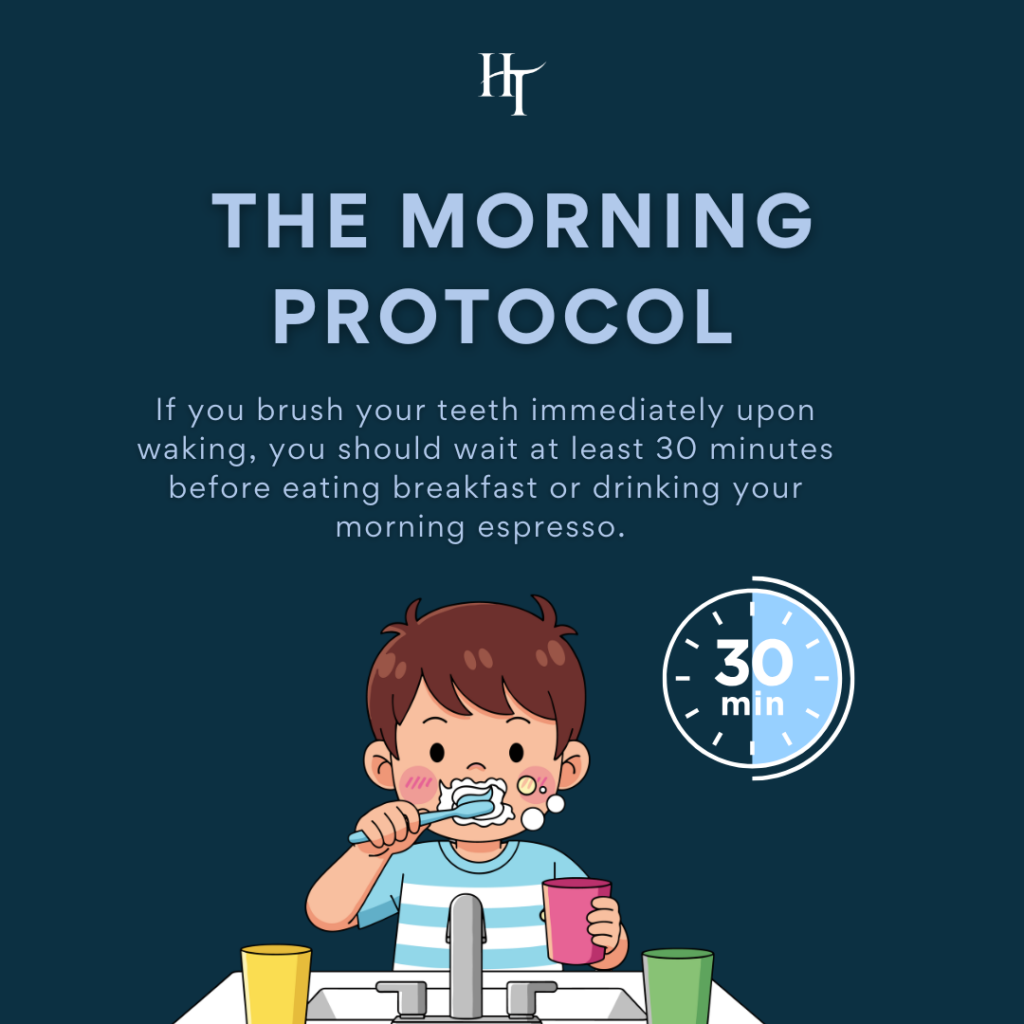
If you brush your teeth immediately upon waking, you should wait at least 30 minutes before eating breakfast or drinking your morning espresso. Modern fluoridated or hydroxyapatite-based toothpaste deposits a concentrated, protective layer of bio-available minerals over your enamel. This micro-layer stabilizes hydroxyapatite crystals against bio-corrosion.
Eating or drinking immediately washes this microscopic shield away before it can chemically fuse with your teeth. Furthermore, drinking dark beverages like espresso immediately after brushing exposes newly cleaned, highly receptive enamel to intense staining pigments. Giving your toothpaste a 30-minute window allows the therapeutic compounds to incorporate fully into the crystalline structure of the tooth, building an acid-resistant barrier for the rest of the morning.
The Post-Meal Protocol (Brushing After Eating)
Conversely, if you prefer to brush after a meal, you must wait at least 30 minutes after your last bite before picking up your toothbrush. When you consume foods—especially acidic items like citrus fruits, yogurt, sourdough bread, or cold-brew coffee—your mouth’s pH drops significantly below the critical threshold of 5.5, temporarily softening the superficial layer of your enamel.
Brushing immediately acts like sandpaper on that softened structure, causing irreversible micro-abrasions and gradual loss of enamel density over time. Waiting 30 minutes allows your saliva to naturally buffer the environment, neutralizing the acid, clearing debris, and safely remineralizing the teeth before physical mechanical cleaning occurs.
- Morning Routine (Pre-Breakfast): Wait 30 minutes after brushing to eat or drink. This allows the active ionic bonding of minerals to the enamel matrix, providing maximum enamel strengthening and stain resistance.
- Post-Meal Routine: Wait 30 minutes after eating to brush. This permits salivary buffering to raise oral pH back above 5.5, which prevents abrasive wear on temporarily softened enamel.
The Biochemistry of Rinsing — Timing the Rinse
Targeting the Deep Oral Cavity
While standard brushing cleans the smooth surfaces of your teeth and flossing clears interdental contact points, these habits leave the posterior tongue, tonsillar pillars, and pharyngeal throat area completely untouched. This is where the therapeutic act of gargling with an antimicrobial rinse plays a vital role in balancing your oral microbiome. The deep posterior surface of the tongue harbors specialized anaerobic micro-crevices where harmful bacterial colonies thrive uninterrupted by basic mechanical brushing.
Dislodging Hidden Bacteria
Utilizing an alcohol-free, therapeutic mouthwash to rinse and deep-gargle for 30 seconds effectively sanitizes the hard-to-reach volatile sulfur compounds (VSCs) and volatile bacterial reservoirs at the very back of the throat. High-performance gargling creates fluid dynamics that mechanically dislodge stagnant biofilms and suppress Porphyromonas gingivalis and other pathogenic species. This significantly lowers the overall bacterial load in your mouth, directly reducing chronic bad breath and protecting your tonsillar tissues from recurring localized inflammatory responses.
The Counter-Intuitive Rule
To maximize your daily preventative dental care, avoid rinsing with water or mouthwash immediately after brushing your teeth. Your toothpaste contains highly concentrated cavity-fighting minerals designed to rest on your teeth and continue working long after you spit out the foam. If you rinse immediately with tap water or even a commercial mouthwash, you flush those valuable nutrients directly down the sink.
Instead, spit out the excess toothpaste slurry and leave the thin film untouched. Utilize your therapeutic mouthwash at a completely separate time of day—such as directly after lunch—to introduce a fresh wave of antimicrobial defense when your saliva production naturally dips, and your teeth need protective reinforcement most.
The Advanced Clean — Clinical Diagnostics
Moving Beyond the Surface
Standard brushing and flossing are excellent baseline defenses, but true, high-yield preventative dental care requires tracking shifts in your anatomy that cannot be seen in a bathroom mirror. Early-stage micro-fractures, subgingival bacterial buildup, and initial bone density shifts develop quietly without producing pain or visible warning signs. Waiting for symptoms to appear changes the clinical equation from conservation to restoration.
Precision Tracking at Waverley Street
At our Palo Alto dental practice, we upgrade traditional hygiene appointments into comprehensive diagnostic audits. We utilize specialized technology to safeguard your smile:
- Sub-Millimeter Digital Imaging: High-resolution digital X-rays that map bone density around your roots with minimal radiation exposure, capturing minor shifts in alveolar support.
- Intraoral Transillumination: Utilizing diagnostic light tech to look through your enamel structures, exposing silent cracks and interproximal cavities long before they register on standard images or turn into painful emergencies.
- Periodontal Pocket Mapping: Computerized measurement tracking of your gum attachment levels to intercept chronic tissue inflammation before it triggers irreversible bone loss.
High-Intent Preventive Dentistry Q&A
While gargling with warm salt water is an exceptional natural remedy for soothing an irritated throat or accelerating healing after a minor oral injury, it does not replace daily therapeutic mouthwash. Salt water acts as a temporary osmotic agent to reduce localized swelling and draw out tissue fluid, but it lacks the advanced anti-plaque, target-specific antimicrobial, and mineralizing agents required to continuously block bacterial colonization and actively reinforce enamel structures.
Even with an immaculate home routine, soft plaque continuously hardens into a mineralized stone called tartar (calculus) in hard-to-clean zones, such as behind the lower front teeth or along the deep margins of your molars. Once tartar forms, it cannot be physically removed by a manual or electric toothbrush. Left unaddressed, this calculus acts as a permanent fortress for pathogenic bacteria, leading directly to gum recession and localized bone destruction. Professional clinical scaling is the only definitive method to safely clear these deposits and preserve your underlying bone structure.
Secure Your Academic & Professional Advantage
Elite preventive dentistry is built on execution and clinical precision. By respecting the 30-minute eating window after brushing, separating your therapeutic mouthwash cycles to preserve fluoride layers, and pairing home habits with advanced clinical tracking, you build a powerful barrier against decay, tissue degradation, and systemic inflammation. Optimizing your daily habits ensures that your smile remains resilient through every demanding season.
Take Action Today
Do not let a preventable dental emergency interrupt your upcoming academic quarter or busy Q4 corporate sprints. Located in downtown Palo Alto at 416 Waverley Street, Dr. Harry Tseng and his experienced associates provide cutting-edge, personalized care designed for our high-performance community. Contact our office today to lock in your comprehensive hygiene and preventative maintenance block before the autumn calendar fills up!