
Blood on your toothbrush is not normal. We hear that excuse all the time from patients in Palo Alto. “My gums have always bled a little.” Healthy gums don’t bleed.
That’s usually the first red flag. It’s not the only one. Your body gives you plenty of signals before gum disease gets serious, and most people just don’t know what to look for. Here’s what should get your attention:
We see patients from the Barron Park area who come in thinking they need a filling. Turns out the real problem is underneath the gumline. That dull ache near the back molars? More often than not it’s gum tissue breaking down, not a cavity.
Gum disease can be painless for months or even years. You might not feel a thing while the bone supporting your teeth slowly deteriorates. According to the CDC, nearly half of adults over 30 have some form of periodontal disease. That number jumps to over 70 percent for adults over 65.
So what does this look like in real life? Maybe you notice your bite feels different. Or a gap appears between two teeth that used to sit tight together. Sometimes it’s something small, like food getting stuck in a spot where it never did before.
Don’t wait for pain to tell you something’s wrong. Pain shows up late in this process. By the time a tooth hurts, you’ve already lost tissue and bone that won’t grow back on its own. If anything on that list sounds familiar, it’s worth a conversation. Early action changes everything with periodontal care and gum health.
We see patients in our Palo Alto office every week who had no idea gum disease has stages. They just know something feels off. Maybe bleeding when they floss. Maybe a tooth that seems a little loose. But the stage you’re in changes everything about how we treat you.
There are three main stages, and each one calls for a different approach:

Most patients we see near the Old Palo Alto neighborhood catch things at gingivitis or early periodontitis. That’s the sweet spot for treatment.
Here’s what surprises people. You can have moderate periodontitis with zero pain. None. Your body is quietly losing bone around your teeth and you feel fine eating dinner. That’s why we measure pocket depths at every visit. Those numbers tell the real story.
According to the CDC, nearly half of adults over 30 have some form of periodontal disease. So if you’re sitting there wondering whether your gums look normal, you’re not alone. And the fact that you’re even thinking about it puts you ahead.
The stage dictates the plan. We don’t guess. We probe, we measure, we take X-rays when needed. Then we tell you exactly where you stand and what it’ll take to get your gums healthy again. Early stages mean simple treatment, later stages mean more involved care. That’s just how it works.
You walk in. We talk. That’s how it starts.
Before anything happens in the chair, we sit down and go over what you’ve been noticing. Bleeding when you floss? Gums pulling back from a tooth? Bad taste that won’t go away? We want to hear all of it. Most people who visit our Palo Alto office have been putting this off for a while, so there’s zero judgment here. We just need the full picture.
Then we move into the exam. Here’s what that actually looks like:
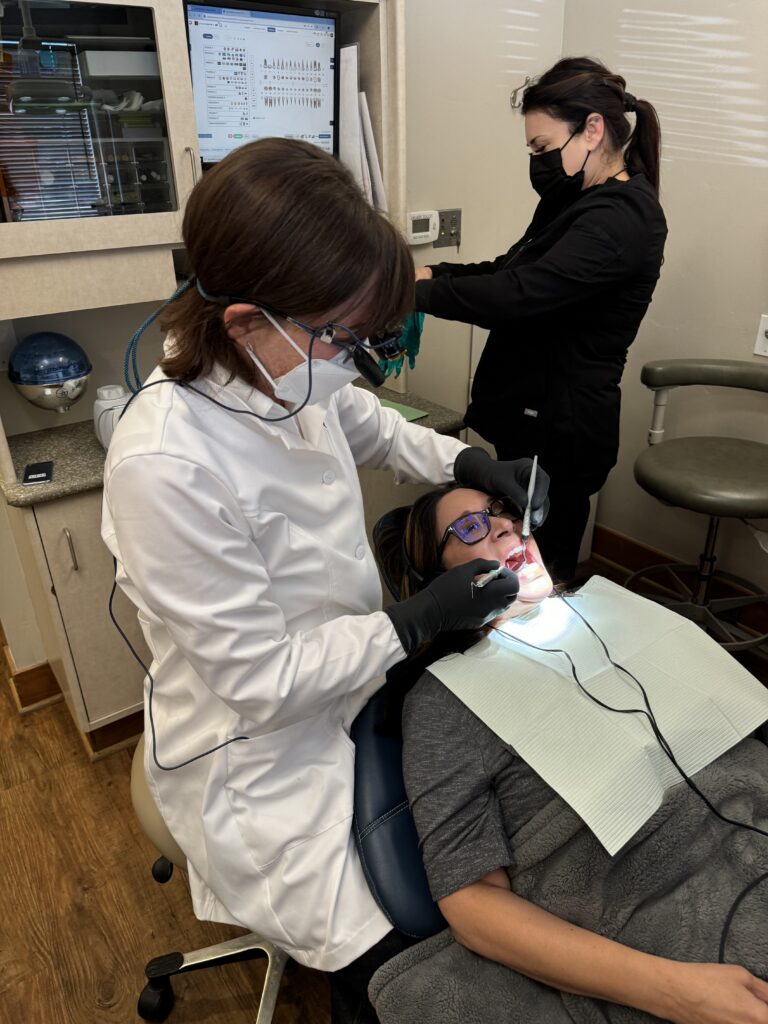
People are often surprised by what the X-rays show. The damage hides well.
If we find early-stage gum disease, we’ll talk about a deeper cleaning called scaling and root planing. It’s not the same as a regular cleaning. We go under the gumline to remove bacteria and hardened buildup that a normal visit can’t reach. For patients near the Crescent Park area who’ve been keeping up with regular checkups but still have deep pockets, this is usually the next step.
If things are more advanced, we’ll map out a clear plan. Our team has years of experience with periodontal care and gum health cases at every stage. You’ll know what we recommend, why we recommend it, and what happens if you wait. No surprises.
The whole first visit usually takes about an hour. You leave with answers, not more questions. That matters to us.
You’ve probably heard the term “deep cleaning” tossed around. Maybe your dentist mentioned it and you weren’t sure how it’s different from a regular cleaning. Here’s the short version: a regular cleaning works above the gumline. A deep cleaning goes below it.
The clinical name is scaling and root planing. We do a lot of these in our Palo Alto office, more than most people would guess.
Scaling means removing plaque and hardened tartar (called calculus) from the tooth surface and from the pockets that form between your gums and teeth. Root planing smooths the root surfaces so your gums can reattach more snugly. That reattachment is the whole goal. When gums pull away from teeth, bacteria move in, the pockets get deeper, and bone loss starts. Scaling and root planing stops that cycle.
Here’s what the process actually looks like:

We typically split the treatment into two visits. One side of the mouth per appointment. It’s easier on you that way, and it lets us be thorough without rushing.
Something we see every week in Palo Alto: patients who put off a deep cleaning because they thought it would hurt. Then afterward they say, “That’s it?” The numbness helps, but the instruments have also gotten much better over the years. You might feel some pressure. Soreness for a day or two after. But real pain? Rare.
The results speak for themselves. Gums that were red and puffy start to firm up. Pockets shrink. Bleeding stops. According to the American Academy of Periodontology, scaling and root planing can reduce pocket depth by up to 1.5 millimeters on average. That’s a big deal when you’re trying to save teeth.
Not sure if deep cleaning is what you need? Give us a call and we’ll measure those pockets first.
Treatment is only half the job. What you do in the months after matters just as much.
We tell every patient the same thing. Your gums healed, now let’s keep them that way. According to the American Academy of Periodontology, patients who skip maintenance visits after treatment are far more likely to see gum disease return. That’s not a scare tactic, it’s just how gum tissue works. It needs consistent care to stay stable.
Our team in Palo Alto sets up a maintenance schedule that fits your life. For most people who’ve gone through scaling and root planing or gum surgery, that means visits every three to four months instead of the standard six. These aren’t regular cleanings. They’re focused appointments where we measure pocket depths, check for new inflammation, and clean below the gumline in spots your toothbrush can’t reach.

What You Can Do at Home
Your daily habits between visits carry real weight. Here’s what we ask our patients to stick with:
The patients who keep their gums healthy long-term are almost always the ones who follow through at home. It’s not complicated. It’s just consistency.
And here’s something people near Midtown or Old Palo Alto don’t always realize. Smoking, stress, and even certain medications can undo months of progress. We talk through all of that with you so nothing catches you off guard.
Some patients worry they’ll be stuck on this tighter schedule forever. Most aren’t. Once your gums stay stable for a year or so, we can often stretch visits back out. But rushing that timeline leads to setbacks we see every week. Give us a call if you’ve finished treatment somewhere else and haven’t been back in a while. We’ll figure out where things stand and get you on track.
We know there are a lot of offices to choose from when you look for a dentist in Palo Alto. Here is some honest advice we give our friends:
Brushing cleans the surfaces, but gum disease usually starts in the tight spaces where your brush can’t reach.
No matter how well you brush, plaque eventually hardens into calculus (tartar), which cannot be removed at home.
Your mouth is a part of your body; what affects your systemic health affects your gums.
If your gums bleed, look puffy, or pull away from your teeth, you likely need more than a regular cleaning. A regular cleaning works above the gumline. Periodontal care goes deeper. We measure pocket depths around each tooth to know exactly what’s happening below the surface. Numbers above 3 millimeters usually mean bacteria have moved in where a standard cleaning can’t reach. The only way to know for sure is to come in and let us check.
It depends on the stage you’re in. Gingivitis, the earliest stage, is fully reversible with a professional cleaning and better home care. Once it progresses to periodontitis, bone loss has already started. That bone won’t grow back on its own. We can stop the damage from getting worse, but we can’t undo what’s already gone. That’s why catching it early matters so much. The sooner you come in, the more options you have.
Your first visit starts with a conversation, not a drill. We ask what you’ve been noticing and go from there. Then we measure pocket depths around each tooth, check for recession and swelling, and take targeted X-rays to see bone levels. We show you everything on screen so nothing is a mystery. Most first visits take about an hour. You leave knowing exactly where your gums stand and what we recommend next.
Most patients are surprised by how manageable it is. We use local anesthetic so you don’t feel the cleaning itself. Some tenderness afterward is normal for a day or two. Over-the-counter pain relief usually handles it. We work one section of the mouth at a time so recovery stays easy. Patients who put it off because they’re nervous almost always tell us it was much easier than they expected.
Palo Alto’s dry air, especially during warmer months, can reduce saliva flow. Less saliva means bacteria stay on your teeth longer. That creates conditions where gum disease can develop faster. We also see a lot of patients here who are busy and skip regular checkups. Gum disease can be painless for months, so it’s easy to miss without professional monitoring. Staying on a consistent schedule with your dental visits makes a real difference here.
Most patients notice improvement within a few weeks after scaling and root planing. Gums stop bleeding, swelling goes down, and pockets often shrink as tissue heals. We schedule a follow-up visit about four to six weeks after treatment to remeasure pocket depths and check your progress. Some cases need additional treatment if pockets stay deep. Healing depends on how advanced the disease was and how well you care for your gums at home between visits.

If you spend much time around University Avenue or grab coffee at Town & Country Village, you see a lot of great smiles. But for many people in our neighborhood, showing their teeth in photos makes them feel shy. Maybe you have a chip from a bike ride at Shoreline Park or your teeth have just gotten yellow over the years from too many lattes. If you are looking for a dentist in Palo Alto, you want someone who can make you look like yourself, just better.
We see so many people from Crescent Park and Midtown who want to fix their smile but don’t want to look “fake.” Finding a dentist in Palo Alto who understands that local, natural look is a big deal. We treat our patients like friends we run into at the California Avenue Farmers’ Market. We want you to feel confident whether you are giving a big talk at Stanford or just meeting friends for dinner in Old Palo Alto.
Most people come to us because they want a Cosmetic Dentist they can trust. A lot of folks ask, “Who is the best cosmetic dentist near me?” The answer is usually someone who listens more than they talk. We don’t just push expensive treatments. We look at your whole face and figure out what will make you feel the most happy.
In a town like Palo Alto, people care about the details. Whether you work in tech or are raising a family in Barron Park, you want your dental work to last. We use the best materials because we want your smile to stand up to real life. Being a Cosmetic Dentist is about more than just white teeth; it’s about making everything line up and feel right when you bite down.
If you have gaps, deep stains, or crooked teeth that you want to fix all at once, Porcelain Veneers are usually the answer. Last year, a local professor came to us because he hated how his teeth looked on Zoom. We used veneers to give him a smile that looked totally real but way brighter.
Porcelain Veneers are very thin shells of ceramic that we bond to the front of your teeth. They are super strong and they don’t stain like regular teeth do. Because we custom-make them for your mouth, we can pick the exact shade and shape. This is a great way to get a “smile makeover” in just a couple of visits. We make sure they match your other teeth so nobody even knows you had work done.
Sometimes you don’t need a whole new smile; you just need to fix one or two small things. That is where Composite Bonding is perfect. If you have a small chip on a front tooth or a little gap that bugs you, we can fix it in one visit.
During Composite Bonding, we use a tooth-colored resin that is kind of like clay. We shape it right on your tooth and then harden it with a special light. It’s much cheaper than veneers and it looks great. A lot of students at Paly High come in for this after sports accidents. It’s a quick way to get your smile back to normal without a big dental bill.
Have you ever felt like your teeth look too short or that your smile is too “gummy?” This is actually really common. We use Gum Contouring to fix the shape of your gum line. We gently remove a little bit of the extra tissue to show off more of your teeth.
Gum Contouring makes a huge difference in how your face looks. It balances everything out. We use modern tools so it heals realy fast and doesn’t hurt much at all. Most people from the Green Gables neighborhood who get this done tell us they can’t believe they waited so long to do it. It’s a small change that makes your whole smile look way more professional and clean.
We know there are a lot of offices to choose from when you look for a dentist in Palo Alto. Here is some honest advice we give our friends:
We love being part of the Palo Alto community and seeing our patients out and about in College Terrace or at the Stanford Shopping Center. If you are ready to love your smile again, come talk to us. We don’t do high-pressure sales; we just want to help you look your best.